Joseph Conrad Today by Kieron O'Hara
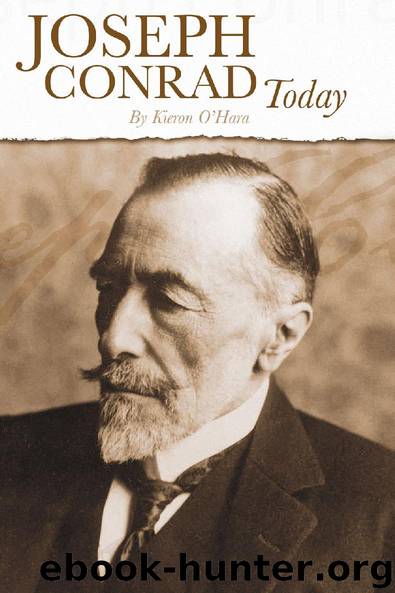
Author:Kieron O'Hara
Language: eng
Format: epub
Tags: Joseph Conrad, novelist, scepticism, pessimism, Heart of Darkness, imperialism, liberal democracy, conservatism, Conradian philosophy, Oakeshott, Salisbury, terrorism, racism, guilt, globalisation, globalization, pity
ISBN: 9781845404147
Publisher: Andrews UK Limited 2016
Published: 2016-06-16T00:00:00+00:00
1 J.O. Urmson, ‘Saints and heroes’, in Joel Feinberg (ed.), Moral Concepts, Oxford: Oxford University Press, 1969, 60-73.
2 Bernard Williams, ‘Moral luck’, in Moral Luck, Cambridge: Cambridge University Press, 1982, 20-39.
Chapter Six
The Roots of Character II: Labour
Work and character
When Conrad was writing, the ‘lower orders’, if they appeared in fiction at all, tended to be ‘ruffians’ or ‘faithful retainers’ in walk-on parts. Rarely did they have anything other than stereotypical lives or characters of their own. Some authors were more ambitious, but Conrad stands out. In many of his novels, especially the sea stories, working class men of coarse manners both good and bad receive careful and plausible characterisation. In the greatest example, The Nigger of the “Narcissus”, the crew of the Narcissus is rendered carefully, with several recognisably individual figures interacting together to weave the story of James Wait’s strange death. We see gallows humour, spontaneous generosity, double-dealing, uncomplaining (and complaining) endurance, shirking, religiosity and lots of hard work.
For some reason due perhaps to the nature of the job, perhaps to the social class of its practitioners, the world of work has never featured strongly in Western literature. But Conrad, with his unique background, was a great believer in the importance, both to the individual and the community, of work and duty. In an essay about the merchant navy, Conrad argues that “A man is a worker. If he is not that, he is nothing.” [1] Twenty years at sea, where the bad effects of shirking and laziness are immediately apparent, had made their mark, and he carried a strong work ethic over into his art (in the ‘Author’s note’ to The Nigger, appropriately enough, he refers to himself as a “workman of art”).
Much of his writing, particularly the non-fiction, tends towards the eulogistic, but is none the worse for that. In fiction he allows himself to be less didactic, and is more realistic, as with Marlow’s “I don’t like work - no man does - but I like what is in the work, - the chance to find yourself. Your own reality - for yourself, not for others - what no man can ever know.” [2]
Life without work is seductive yet corrupting. Almayer is an example of someone with too much time to think and too little to do, while the spies in The Secret Agent are characterised by indolence and sponging off others. The Shadow-Line, a semi-autobiographical novel published in 1917, begins with the unnamed narrator believing he has lost interest in the sea, and abruptly resigning his position as first mate. Even though “I could not have been happier if I had had the life and the men made to my order by a benevolent Enchanter”, he quits, “in that, to us, inconsequential manner in which a bird flies away from a comfortable branch.” In retrospect, “My action, rash as it was, had more the character of divorce - almost of desertion.” His decision goes down very badly with his fellow officers, and he is handed his papers at the harbour office “as if they had been my passports for Hades.
Download
This site does not store any files on its server. We only index and link to content provided by other sites. Please contact the content providers to delete copyright contents if any and email us, we'll remove relevant links or contents immediately.
Cecilia; Or, Memoirs of an Heiress — Volume 2 by Fanny Burney(31956)
Cecilia; Or, Memoirs of an Heiress — Volume 3 by Fanny Burney(31942)
Fanny Burney by Claire Harman(26603)
We're Going to Need More Wine by Gabrielle Union(19046)
Plagued by Fire by Paul Hendrickson(17413)
All the Missing Girls by Megan Miranda(16029)
Cat's cradle by Kurt Vonnegut(15357)
For the Love of Europe by Rick Steves(14121)
Bombshells: Glamour Girls of a Lifetime by Sullivan Steve(14076)
Leonardo da Vinci by Walter Isaacson(13337)
4 3 2 1: A Novel by Paul Auster(12393)
The remains of the day by Kazuo Ishiguro(9000)
Adultolescence by Gabbie Hanna(8927)
Note to Self by Connor Franta(7671)
Diary of a Player by Brad Paisley(7581)
Giovanni's Room by James Baldwin(7346)
What Does This Button Do? by Bruce Dickinson(6207)
Ego Is the Enemy by Ryan Holiday(5450)
Born a Crime by Trevor Noah(5383)
